
Bluehost for Beginners 2026: Is It Easy to Use?
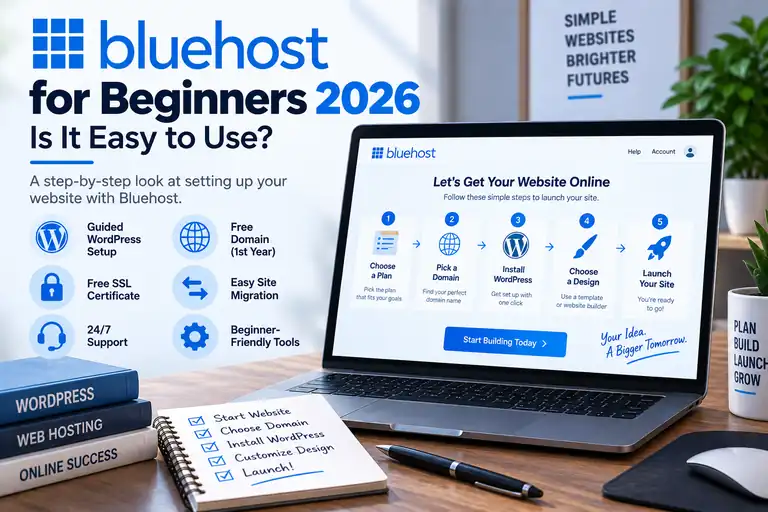
Bluehost is frequently marketed to first-time website owners, but how easy is it if you've never purchased hosting, connected a domain or installed WordPress before?
In this guide, we walk through Bluehost for beginners from signup to launching a website, including its current WordPress setup, website builder, domain tools and hosting dashboard.
The goal isn't just to tell you Bluehost is beginner-friendly. We'll show you which parts Bluehost simplifies, what you'll still need to learn and where beginners can run into confusion.
Starting your first website involves several pieces that may be completely unfamiliar: web hosting, domain names, DNS, WordPress, themes, plugins, SSL and website backups.
A beginner-friendly host should reduce how many of those things you have to configure manually just to get a basic website online.
That's where Bluehost's current setup process is useful.
Bluehost provides guided WordPress installation, a website creation flow, hosting management tools and migration options inside its platform. Its current WordPress Website Builder even lets users identify themselves as beginners so the setup experience can provide more guidance.
If you want our full assessment of the company rather than just its ease of use, read our Bluehost Review 2026.
Is Bluehost Good for Beginners?
Bluehost is particularly well suited to beginners who want to build a WordPress website without manually configuring the hosting environment.
You don't need to download WordPress, upload files with FTP, manually create a MySQL database and edit configuration files just to launch a normal WordPress site.
Instead, Bluehost's current Portal lets you select Websites → Add Website → WordPress and proceed through the setup process.
Bluehost also provides its WordPress Website Builder experience for users who want additional help creating the site's initial design and structure.
What Do You Need Before Starting?
At a basic level, a new website needs three major things:
- A domain name — the address people type to visit the website.
- Web hosting — the server environment where the website lives.
- Website software — WordPress is the option we're focusing on here.
Bluehost can combine those pieces into one setup process.
Eligible hosting plans currently include a domain for the first year, and WordPress can be installed through the Bluehost Portal.
If the terminology is still unfamiliar, our How to Choose a Web Host in 2026 guide explains the hosting side in more detail.
Step 1: Choose a Bluehost Hosting Plan
Your first decision is the hosting plan.
For many beginners creating a normal blog, portfolio or small-business website, there is usually no reason to start with Bluehost's most expensive plan.
Bluehost's current Starter WordPress plan supports up to 10 websites and includes 10 GB of NVMe SSD storage along with features such as SSL, CDN, managed WordPress updates and migration tools.
We've broken down the current introductory and renewal costs separately in our Bluehost Pricing 2026 guide.
The biggest pricing lesson for a beginner is simple: look at both the introductory rate and the renewal rate before buying.
Step 2: Choose Your Domain Name
Your domain is your website's permanent address, such as yourbusiness.com.
Bluehost's current eligible hosting plans include a free domain for the first year.
That makes initial setup easier because you can select the domain while creating the hosting account rather than buying it somewhere else and immediately learning how to change DNS settings.
Tips for Choosing a First Domain
- Keep it reasonably short.
- Make it easy to spell.
- Avoid unnecessary numbers and special characters.
- Choose something that can still make sense if the website grows.
- Double-check the spelling before registering it.
Remember that the domain isn't permanently free. Eligible Bluehost plans include the initial registration period, after which the domain has its own renewal cost.
Step 3: Install WordPress
This is an area where Bluehost removes a lot of work for beginners.
Bluehost's current installation process starts inside the Portal:
- Log in to the Bluehost Portal.
- Open Websites.
- Select Add Website.
- Choose WordPress.
- Continue through the guided setup.
For most beginners, there is no need to perform a manual WordPress installation.
Manual installation is still possible for advanced situations, but it involves downloading WordPress, uploading the files, creating a database and configuring WordPress yourself.
The Portal setup eliminates those unnecessary steps for a normal first website.
Step 4: Use Bluehost's WordPress Website Builder
Bluehost's current WordPress Website Builder is particularly relevant to beginners.
During onboarding, you can choose between starting with a template or following a more guided website-creation flow.
Bluehost then asks about the website and uses those answers to help create initial design options.
One of the more interesting parts of the current setup is the experience-level selection.
You can identify yourself as:
- Beginner — first time using WordPress and you want more assistance.
- Intermediate — you've used WordPress but aren't an expert.
- Advanced — you're comfortable working with WordPress.
The onboarding experience is then tailored around that selection.
That is a genuinely useful beginner feature because someone building a first website doesn't necessarily need the same workflow as an experienced WordPress developer.
Step 5: Choose Your Website Design
You don't need to design every page from a blank screen.
Bluehost's current WordPress website creation flow can generate initial design options based on the information you provide during onboarding.
You can then customize elements such as:
- Colors
- Fonts
- Page layouts
- Images
- Navigation
- Content
Because the site is still based on WordPress, you're not permanently limited to the initial setup.
You can continue customizing the site through WordPress after it has been created.
Step 6: Learn the WordPress Dashboard
Bluehost can simplify the setup, but you'll still need to learn some WordPress basics.
The WordPress dashboard is where you'll typically manage:
- Posts
- Pages
- Images and media
- Comments
- Themes
- Plugins
- Users
- Website settings
The good news is that learning WordPress is useful beyond Bluehost.
If you eventually move the site to another WordPress host, the fundamental WordPress interface and concepts remain familiar.
Step 7: Create the Essential Pages
A first website doesn't need dozens of pages before launch.
A small-business website might initially need only:
- Home
- About
- Services or Products
- Contact
- Privacy Policy
A blog may start with Home, About, Contact and its first few posts.
Get the essential structure working before worrying about every possible feature you may want six months from now.
Step 8: Install Only the Plugins You Need
WordPress plugins add functionality to your website.
Examples include contact forms, SEO tools, caching, security features and eCommerce functionality.
One of the most common beginner mistakes is installing too many plugins simply because they're available.
Every plugin adds another component that needs to be maintained and updated.
Start with the functionality the website actually needs and add more later when there is a specific reason.
Step 9: Check Security and Backups
Bluehost handles part of the security environment, but beginners still have responsibilities.
At minimum:
- Use a strong Bluehost account password.
- Use a strong WordPress administrator password.
- Keep WordPress updated.
- Keep plugins and themes updated.
- Remove plugins you're no longer using.
- Make sure HTTPS is working.
- Maintain reliable backups.
See our How to Secure Your Website and How to Back Up Your Website guides for the full process.
Step 10: Launch Your Website
Before telling everyone your new website is ready, check the basics.
- Open every page.
- Test the navigation.
- Test contact forms.
- Check the site on a phone.
- Make sure HTTPS is active.
- Remove placeholder content.
- Check spelling and contact information.
- Confirm important links work.
Your first website doesn't need to be perfect before launch.
It needs to work, clearly explain what it is about and give visitors an obvious next step.
Is Bluehost's Dashboard Easy to Use?
For ordinary website management, Bluehost tries to keep the most common tasks inside its Portal rather than forcing beginners to work directly with server configuration.
The Websites section provides access to individual sites, while the WordPress installation and site-building workflows guide users through common setup tasks.
More advanced users still have access to additional hosting-management tools when needed.
This creates a useful progression: beginners can start with the guided tools and learn the more technical parts only when they actually need them.
Do You Need to Know How to Code?
No. You do not need to know HTML, CSS, PHP or JavaScript to create a basic WordPress website with Bluehost.
WordPress themes, blocks, templates and Bluehost's setup tools handle most of the visual construction.
Learning some HTML or CSS later can be useful for customization, but coding knowledge is not a requirement for getting a normal website online.
Can a Beginner Move an Existing Site to Bluehost?
Yes. Bluehost currently provides a WordPress self-service migration option for moving an existing WordPress website.
Bluehost also provides migration services for situations that require additional help.
That means you don't necessarily have to rebuild an existing WordPress site from scratch just because you're changing hosting companies.
What Happens If You Get Stuck?
Bluehost provides support resources in addition to the hosting platform itself.
Its current knowledge base covers WordPress installation, themes, plugins, migrations and other common setup tasks.
Bluehost also operates a free WordPress Academy with tutorials and structured lessons covering WordPress setup and website management.
That's useful for beginners because hosting support won't necessarily build or redesign the entire website for you.
There will still be WordPress skills you'll gradually learn yourself.
What Beginners May Not Like About Bluehost
Bluehost isn't completely frictionless.
There are several things a first-time user should understand.
Renewal Pricing
The lowest advertised rates are introductory offers. Your hosting can cost more when the initial term ends.
WordPress Still Has a Learning Curve
Bluehost makes WordPress easier to install and set up, but WordPress itself has themes, plugins, pages, menus and settings you'll need to learn.
There Are Lots of Hosting Options
Beginners can become distracted by plan upgrades and additional services they may not actually need.
Start with the requirements of the website you're building rather than assuming a more expensive plan is automatically better.
Bluehost for Beginners: Pros and Cons
| Pros | Cons |
|---|---|
| Guided WordPress setup | Renewal price is higher than introductory pricing |
| Beginner-focused website builder | WordPress still takes time to learn |
| Free domain first year on eligible plans | Longer commitment typically required for lowest promotional price |
| Free SSL | Beginners still need to learn basic site maintenance |
| WordPress migration options | Not every website problem is handled by hosting support |
Bluehost vs Building a Website Somewhere Else
Bluehost's biggest advantage for a beginner is that you get a real WordPress website while still receiving guided setup.
That's different from choosing a completely proprietary website builder where the site is tightly tied to that company's platform.
WordPress gives you a large ecosystem of themes and plugins and makes it possible to move the website to another compatible host later.
The tradeoff is that WordPress requires more learning than the simplest closed website builders.
Is Bluehost Good for a First Business Website?
For many small businesses, yes.
A basic business website usually doesn't require advanced server administration. It needs reliable hosting, HTTPS, a professional design, contact functionality and a straightforward way to update content.
Bluehost and WordPress can provide that without requiring the business owner to manage a server.
For other options, compare our Best Web Hosting for Small Business 2026 guide.
Is Bluehost Good for a First Blog?
Bluehost is also a logical option for a first WordPress blog.
WordPress was built around publishing content, and Bluehost removes much of the technical work involved in initially installing it.
You can concentrate on learning posts, categories, images and SEO rather than configuring the server underneath the site.
Is Bluehost Worth It for Beginners in 2026?
For someone building a first WordPress website, Bluehost offers a strong combination of guided setup and room to grow.
The current onboarding process can guide you through WordPress installation, initial site creation and design without requiring coding or manual server configuration. Bluehost's Website Builder also adjusts its onboarding based on your stated WordPress experience level.
The biggest thing we'd tell a beginner before signing up is to understand the long-term price. Bluehost's promotional pricing can make the initial term inexpensive, but the hosting renews at a higher standard rate.
If you're comfortable with the renewal cost and want to build a WordPress website rather than use a closed website-building platform, Bluehost is a strong option to consider.
Bluehost features, pricing and promotions can change. Verify the current plan details and renewal terms before purchasing.