
SiteGround vs Bluehost 2026: Which Web Host Is Better?
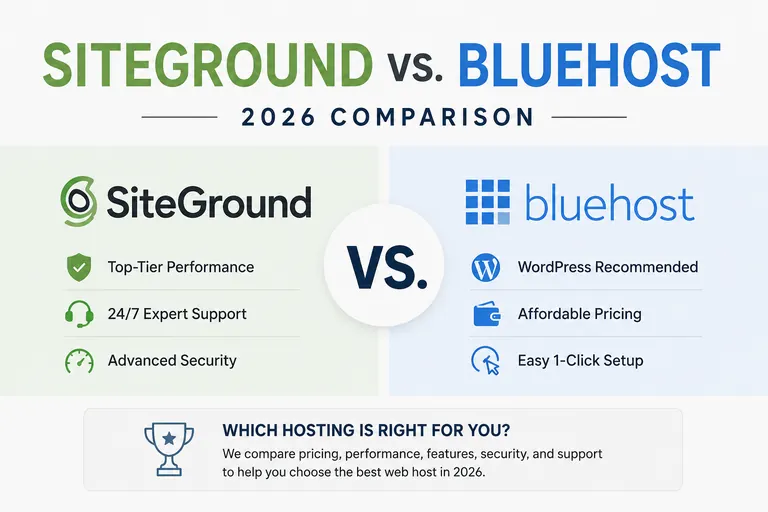
SiteGround vs Bluehost pits a feature-rich managed WordPress platform against one of the easiest hosting options for beginners.
SiteGround stands out for its Site Tools interface, managed WordPress features and advanced tools on GrowBig and GoGeek. Bluehost focuses on simple onboarding and straightforward WordPress website creation.
Our pick: Bluehost for most beginners. SiteGround is the better fit for users who specifically want its more advanced managed WordPress tools.
SiteGround vs Bluehost: Pros and Cons
| Host | Pros | Cons |
|---|---|---|
| SiteGround | Strong managed WordPress tools, daily backups, staging on higher plans, excellent caching and security features | Higher renewal pricing and no cPanel |
| Bluehost | Excellent beginner onboarding, strong WordPress integration, free SSL, easy website setup | Renewal prices increase after the introductory term and some features require higher plans |
SiteGround vs Bluehost: Which Is Better?
Bluehost is our overall winner for most beginners, while SiteGround is the stronger choice for experienced WordPress users who will take advantage of its managed tools.
These are both strong WordPress hosts, but they're aimed at somewhat different customers.
Bluehost makes launching and managing a first WordPress website relatively straightforward. SiteGround puts more emphasis on managed WordPress functionality, backups, caching, staging and developer tools.
For the typical person building a first website, we give Bluehost the edge. For an established WordPress site where staging, daily backups and advanced management tools matter, SiteGround can be worth the additional cost.
SiteGround vs Bluehost Quick Comparison
| Feature | SiteGround | Bluehost |
|---|---|---|
| Best For | Managed WordPress & advanced users | Beginners & first WordPress sites |
| Control Panel | Site Tools | Bluehost dashboard |
| WordPress | Excellent | Excellent |
| Daily Backups | Yes | Depends on plan |
| Staging | Available on qualifying plans | Available on qualifying plans |
| Free SSL | Yes | Yes |
| Our Overall Winner | Best for advanced WordPress | ✓ Bluehost |
Hosting pricing, features and promotional terms can change. Verify current plan details before purchasing.
SiteGround vs Bluehost Pricing
Both SiteGround and Bluehost offer discounted introductory hosting prices, followed by higher regular renewal rates.
SiteGround's renewal pricing is particularly important because its regular rates position it closer to premium hosting than budget shared hosting.
That higher cost can make sense if you're actually using SiteGround's managed WordPress tools, daily backups, staging and additional resources.
For a basic first website, Bluehost generally provides the better balance between cost and functionality.
SiteGround vs Bluehost for WordPress
This is the most important category in the comparison because WordPress is a major strength for both companies.
Bluehost emphasizes easy WordPress setup and management. It's particularly well suited to someone who wants to get a site online without learning the technical side of hosting.
SiteGround offers a more advanced WordPress environment. Features such as daily backups, caching, staging on qualifying plans and developer tools make it attractive to experienced website owners.
For beginners, Bluehost wins. For advanced WordPress management, SiteGround wins.
We compare both providers with other leading options in our Best WordPress Hosting 2026 guide.
Which Is Easier to Use?
Bluehost gets the advantage for first-time website owners.
Its dashboard is designed around website and WordPress management, reducing the number of technical decisions a beginner has to make when launching a site.
SiteGround's Site Tools interface is also well designed, but the overall platform exposes more functionality that becomes valuable as a website owner gains experience.
Ease-of-use winner: Bluehost.
SiteGround vs Bluehost Performance
SiteGround puts significant emphasis on performance, with server-side caching, CDN functionality and WordPress optimization tools built into its hosting environment.
Bluehost also provides modern storage, CDN functionality and WordPress performance features.
For a basic website, either platform can provide solid performance when the site is properly optimized. For more demanding WordPress sites, SiteGround's caching and resource-management tools give it an advantage.
Performance winner: SiteGround.
SiteGround vs Bluehost Backups
SiteGround has a clear advantage in this category because daily automated backups are a core part of its hosting platform.
Higher SiteGround plans also provide additional backup functionality, including on-demand backups.
Bluehost provides backup features as well, but the exact functionality depends on the selected hosting plan.
Backup winner: SiteGround.
SiteGround vs Bluehost Staging
A staging environment creates a private copy of a website where changes can be tested before being pushed to the live site.
This is especially valuable when changing themes, updating major plugins or modifying a business website.
Both providers offer staging functionality on qualifying plans, but SiteGround's staging workflow is one of the features that makes its higher-tier WordPress hosting particularly attractive.
Staging winner: SiteGround.
SiteGround vs Bluehost Security
Both providers include free SSL and multiple security features.
SiteGround places significant emphasis on managed security and server-level protections, while Bluehost provides additional malware, firewall and security functionality depending on the selected plan.
For website owners who want more security management handled by the host, SiteGround gets a slight advantage.
Security winner: SiteGround.
SiteGround vs Bluehost Customer Support
Both companies provide around-the-clock customer support.
SiteGround has built a strong reputation around support and provides priority support on its GoGeek plan.
Bluehost provides 24/7 chat and phone support on qualifying plans, which is particularly useful for beginners who prefer speaking directly with someone.
Support winner: Very close.
SiteGround vs Bluehost for Beginners
Bluehost is the better choice for most beginners.
A new website owner generally needs an easy way to connect a domain, install WordPress, activate SSL and start building the site.
Bluehost's onboarding process is designed around that type of customer.
SiteGround isn't difficult to use, but some of its biggest advantages are features a first-time website owner may not need yet.
Beginner winner: Bluehost.
SiteGround vs Bluehost for Small Business
This category depends on the type of business website.
For a straightforward local-business or professional-service website, Bluehost provides a strong combination of ease of use and functionality.
For an established business that frequently makes WordPress changes or places greater value on staging, backups and managed hosting tools, SiteGround can justify its higher long-term cost.
We compare both with other business-focused options in our Best Web Hosting for Small Business 2026 guide.
Who Should Choose SiteGround?
Choose SiteGround if you:
- Want advanced managed WordPress tools
- Value daily automated backups
- Use WordPress staging regularly
- Want strong caching and performance functionality
- Manage an established business website
- Are comfortable paying more at renewal for additional features
Who Should Choose Bluehost?
Choose Bluehost if you:
- Are building your first WordPress website
- Want a straightforward setup process
- Prefer beginner-friendly WordPress management
- Don't need advanced development tools
- Are building a blog, affiliate site or small-business website
- Want our overall recommendation between these two hosts
See Bluehost Plans & Current Offer →
SiteGround vs Bluehost: Final Verdict
Bluehost wins our SiteGround vs Bluehost comparison for the typical website owner in 2026.
SiteGround is the stronger platform in several technical categories, particularly backups, staging and managed WordPress functionality.
But those advantages come with substantially higher renewal pricing, and many new website owners won't need all of those advanced features.
Bluehost provides the better overall balance for someone launching a first WordPress site, blog, affiliate website or straightforward small-business website.
Choose Bluehost for simplicity and beginner-friendly WordPress hosting. Choose SiteGround when advanced WordPress tools and managed features justify the additional cost.
Check Bluehost's Current Pricing →
SiteGround vs Bluehost FAQ
Is SiteGround better than Bluehost?
SiteGround can be better for experienced WordPress users who value staging, daily backups and advanced managed tools. We prefer Bluehost for the typical first-time WordPress website owner.
Which is better for WordPress?
Both are strong WordPress hosts. Bluehost gets our edge for beginners, while SiteGround gets the edge for more advanced WordPress management.
Which is better for beginners?
Bluehost is our winner for beginners because of its straightforward WordPress onboarding and website-management experience.
Which has better backups?
SiteGround gets the advantage because daily automated backups are included and higher plans provide additional backup functionality.
Which is better for staging?
SiteGround is particularly strong for WordPress staging and gets our advantage for users who regularly test website changes before publishing them.
Do SiteGround and Bluehost include free SSL?
Yes. Both providers include free SSL with qualifying hosting plans.
Does SiteGround use cPanel?
No. SiteGround uses its proprietary Site Tools hosting dashboard.
Which host would we choose?
For a first WordPress website, we would choose Bluehost. For an established WordPress website where staging, daily backups and advanced managed tools are priorities, we would seriously consider SiteGround.
Affiliate Disclosure: WebHostRanking.com may receive compensation if you purchase Bluehost through links on this page. This does not increase the price you pay. Hosting pricing, features and promotional terms can change, so verify current details before purchasing.