
VPS vs Cloud Hosting 2026: What’s the Difference?
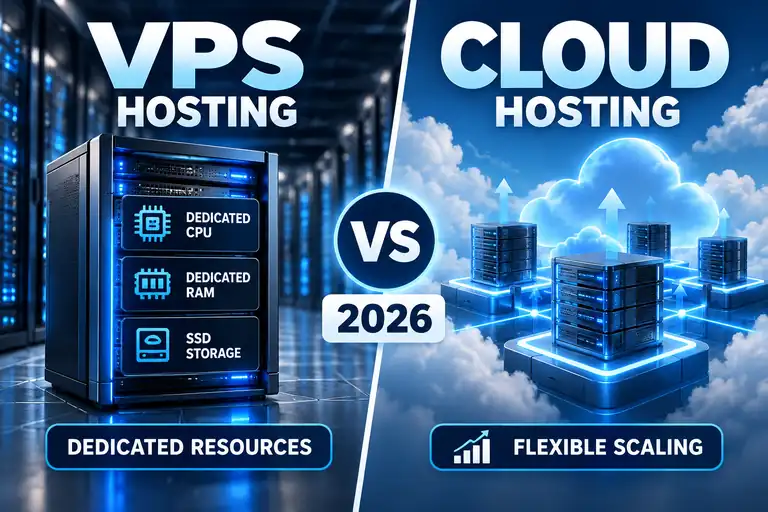
VPS hosting and cloud hosting can both provide substantially more resources and control than basic shared hosting, but the infrastructure behind them isn't necessarily the same.
A traditional VPS typically provides an isolated virtual server with a defined allocation of CPU, RAM and storage. Cloud hosting can distribute workloads across a larger pool of infrastructure and is generally designed to make resources easier to scale as demand changes.
This VPS vs cloud hosting comparison explains the differences in performance, scalability, reliability, pricing and management so you can determine which approach fits your website or application.
Compare VPS vs Cloud Hosting →
Quick answer: Traditional VPS hosting is often a strong fit when you want defined resources, server control and predictable costs. Cloud hosting is particularly useful when scalability, infrastructure flexibility and handling changing workloads are priorities.
VPS and cloud hosting are frequently discussed as competing hosting technologies, but the distinction isn't always as simple as it appears. Both rely heavily on virtualization, and modern hosting companies sometimes combine characteristics of both.
The traditional difference is the underlying infrastructure. A VPS is commonly an isolated virtual environment running on a physical server with a defined allocation of resources. Cloud hosting generally uses a broader pool of virtual and physical infrastructure from which computing resources can be provisioned and scaled.
Understanding that distinction can help you avoid choosing hosting based solely on marketing terminology.
VPS vs Cloud Hosting: Quick Comparison
| Feature | Traditional VPS | Cloud Hosting |
|---|---|---|
| Infrastructure | Virtualized environment traditionally tied to a physical host | Resources drawn from broader cloud infrastructure |
| Resources | Defined CPU, RAM and storage allocation | Can be provisioned more dynamically |
| Scaling | Often requires changing server resources or plan | Designed for easier elastic scaling |
| Pricing | Often fixed or predictable plan pricing | May use fixed or usage-based pricing |
| Control | Often includes extensive server control/root access | Varies substantially by cloud platform |
| Reliability | Can depend more heavily on its underlying host infrastructure | Can use distributed infrastructure and redundancy |
| Best Fit | Predictable workloads needing dedicated resources and control | Changing workloads requiring flexible scalability |
What Is VPS Hosting?
VPS stands for Virtual Private Server. Virtualization software divides physical server resources into isolated virtual server environments.
A VPS typically receives an allocation of resources such as CPU, RAM and storage. Unlike basic shared hosting, where many hosting accounts share a common resource pool, VPS hosting provides a much more isolated environment.
Depending on the hosting provider and management level, a VPS may also provide root access and extensive control over server software and configuration.
VPS hosting therefore sits naturally between shared hosting and a dedicated physical server. It provides significantly greater control without requiring you to rent an entire physical machine.
See our Best VPS Hosting comparison for current VPS options.
What Is Cloud Hosting?
Cloud hosting uses virtualized computing resources delivered from cloud infrastructure rather than relying exclusively on the traditional model of one website or virtual environment being tied to one physical server.
The important advantage is access to a larger resource pool. Depending on the cloud platform, CPU, memory, storage and other resources can be provisioned or adjusted as requirements change.
This architecture can make cloud hosting particularly useful for websites and applications with rapidly changing traffic or workloads.
Cloud infrastructure can also be designed with redundancy across multiple systems, reducing dependence on a single piece of physical hardware.
For provider options, see our Best Cloud Hosting comparison.
VPS vs Cloud Hosting: The Biggest Difference
The fundamental difference is not simply that one uses virtualization and the other doesn't. Both can use virtual machines.
The more useful distinction is the infrastructure from which those virtual resources are provided.
A traditional VPS generally operates as an isolated virtual environment on a physical host. Its assigned CPU, memory and storage are defined by the VPS configuration.
A cloud environment can draw from a larger infrastructure pool, making it easier to provision additional resources or distribute workloads across more infrastructure.
Important: VPS and cloud hosting are not mutually exclusive. A provider can deploy virtual private servers on cloud infrastructure. This is why you'll also encounter products described as Cloud VPS.
Which Is Easier to Scale?
Scalability is one of cloud hosting's defining characteristics.
Cloud platforms are designed so computing resources can be increased or decreased as workloads change. Depending on the architecture, this may include scaling CPU, memory, storage or the number of server instances supporting an application.
Traditional VPS hosting can also be scaled. You may be able to move to a larger VPS with additional CPU, RAM and storage, but the process is generally based around resizing or upgrading a particular virtual server.
Cloud infrastructure can go further by allowing applications to use multiple instances and more dynamic resource provisioning.
Which Offers Better Performance?
Neither VPS nor cloud hosting is automatically faster simply because of its label.
Real-world performance depends on the hardware, CPU allocation, memory, storage technology, network, data center location, software stack, caching and configuration.
A properly configured VPS with adequate resources can deliver excellent website performance. A cloud environment can likewise perform extremely well and may provide additional options for distributing demanding workloads.
If your website is slow, moving hosting platforms isn't always the first answer. See our How to Speed Up Your Website guide before assuming that more expensive infrastructure will solve every performance issue.
Which Is More Reliable?
Traditional VPS infrastructure can depend more heavily on the physical host supporting the virtual server. Hosting providers can use redundant systems and other safeguards, but the architecture may still have a greater dependency on a particular host machine.
Cloud infrastructure can be designed to distribute workloads across a larger pool of servers. Properly implemented redundancy can allow workloads to continue or recover when individual infrastructure components fail.
However, the word cloud by itself does not guarantee high availability. The provider's actual architecture and the way an application is configured matter.
VPS vs Cloud Hosting Pricing
Traditional VPS plans frequently use straightforward monthly or annual pricing. You select a resource configuration and pay for that server plan.
That makes budgeting relatively simple because you know the server's basic recurring cost.
Cloud pricing can work differently. Some platforms charge based on the resources actually consumed, while managed cloud hosting providers may package cloud resources into conventional monthly plans.
Usage-based billing offers flexibility, but it can also make costs less predictable when workloads fluctuate substantially.
When comparing prices, don't compare the advertised monthly numbers alone. Look at CPU, RAM, storage, bandwidth, management, backups, control panels and support.
Managed vs Unmanaged Hosting Matters Too
The VPS versus cloud distinction isn't the only decision you need to make. You also need to consider who will manage the server.
With managed hosting, the provider handles more of the underlying server administration. The exact services vary, but management can include operating-system maintenance, security assistance, monitoring and technical support.
With unmanaged infrastructure, more responsibility falls on you or your technical team.
A managed VPS may therefore be much easier for a small business to operate than an unmanaged cloud server, even if cloud infrastructure is technically more scalable.
When Does VPS Hosting Make Sense?
VPS hosting can be a good fit when your website has outgrown shared hosting and you want a defined amount of computing resources without moving all the way to a dedicated physical server.
Common VPS use cases include:
- Growing business websites
- Higher-traffic WordPress websites
- Ecommerce stores
- Web applications
- Agency hosting environments
- Development and testing environments
- Custom server configurations
VPS is also attractive when predictable monthly costs and server-level control are priorities.
When Does Cloud Hosting Make Sense?
Cloud hosting becomes particularly attractive when resource requirements change frequently or an application needs infrastructure that can expand beyond a single virtual server.
Common cloud-hosting use cases include:
- Websites with unpredictable traffic spikes
- Growing ecommerce platforms
- SaaS applications
- Applications requiring scalable infrastructure
- Businesses that need geographic infrastructure options
- Workloads requiring flexible resource provisioning
Cloud infrastructure can also make sense when redundancy and the ability to build across multiple infrastructure resources are major priorities.
What About Cloud VPS Hosting?
This is where the terminology becomes confusing.
A Cloud VPS combines characteristics of both technologies. You still receive a virtual server environment, but that environment is deployed on cloud infrastructure rather than the classic model of relying on a single physical VPS host.
That can provide the familiar server control of VPS hosting while benefiting from aspects of cloud infrastructure.
Our InMotion VPS Review looks at one VPS option in more detail, while our cloud-hosting comparison covers providers using several different cloud approaches.
VPS vs Cloud Hosting for WordPress
Most small WordPress websites need neither a VPS nor complex cloud infrastructure.
A quality shared or managed WordPress hosting plan can be simpler and less expensive for a typical blog, portfolio or small-business website.
VPS or cloud hosting becomes more relevant when WordPress traffic, database activity, ecommerce workloads or custom server requirements exceed what conventional hosting comfortably supports.
Before upgrading, compare the options in our Best WordPress Hosting guide.
VPS vs Cloud Hosting for Small Business
A small business should generally choose based on its actual workload rather than automatically selecting the more advanced technology.
A business website with relatively predictable traffic may value a managed VPS because it provides dedicated resources and a straightforward hosting environment.
A business running an application with rapidly changing demand may benefit more from cloud infrastructure capable of scaling resources as requirements change.
For less demanding business websites, conventional hosting may still be sufficient. See our Best Web Hosting for Small Business guide for those options.
How to Choose Between VPS and Cloud Hosting
Start with the workload rather than the hosting label.
| If You Prioritize... | Consider Starting With... |
|---|---|
| Predictable server resources | VPS |
| Simple recurring server cost | VPS |
| Root-level server control | VPS or cloud VM |
| Rapidly changing workloads | Cloud |
| Elastic infrastructure | Cloud |
| Distributed architecture | Cloud |
The provider and specific hosting architecture ultimately matter more than the category name. Read the actual resource allocation, management level, scaling process, backup policy and infrastructure details before purchasing.
Frequently Asked Questions
Is cloud hosting better than VPS?
Not universally. Cloud hosting is particularly useful when flexible scaling and distributed infrastructure are priorities. A VPS can be an excellent choice when you want defined resources, extensive server control and predictable costs.
Is VPS hosting the same as cloud hosting?
No. A traditional VPS is a virtual server environment typically associated with resources allocated on a physical host. Cloud hosting uses a broader pool of infrastructure. However, VPS instances can also be deployed on cloud infrastructure.
Can a VPS be hosted in the cloud?
Yes. Cloud VPS products combine a virtual private server environment with cloud-based infrastructure.
Which is cheaper, VPS or cloud hosting?
It depends on the provider, resources and workload. VPS hosting often has predictable plan-based pricing, while some cloud services charge according to actual resource usage. Either model can cost more depending on how much infrastructure you consume.
Which is better for high traffic?
Both can support high-traffic websites when properly provisioned. Cloud infrastructure can be particularly useful when traffic changes rapidly because resources can be designed to scale with demand.
Do I need VPS or cloud hosting for a small website?
Usually not. Many small websites are adequately served by quality shared or managed WordPress hosting. More advanced infrastructure becomes useful when traffic, applications or resource requirements justify it.
Final Thoughts
VPS and cloud hosting both represent major steps beyond basic shared hosting, but they solve somewhat different infrastructure problems.
A traditional VPS emphasizes an isolated server environment with defined resources and substantial control. Cloud hosting emphasizes flexible infrastructure, scalability and the ability to draw computing resources from a broader pool.
There's also substantial overlap. Modern Cloud VPS products combine features from both approaches, which means the specific provider architecture is more important than the marketing label.
Continue your research with our Best VPS Hosting and Best Cloud Hosting comparisons.